4 min read
Advance payments for made-to-order pieces
Starting a ₹12,000 lehenga on a promise is a risk. How to take advances for made-to-order pieces — with a payment link you send, not a forced checkout.
Picture a boutique owner buying fabric on a Monday. Georgette, dyed to match a photo a customer sent, plus lining, plus the embroiderer's advance — ₹4,000 out of her pocket before a single stitch. The customer was lovely, enthusiastic, completely sincere. She was also, three weeks later, "so sorry, the wedding plans changed."
The piece now hangs in the shop in someone else's measurements. Every made-to-order boutique has one of these — the beautiful, unsellable monument to a promise. And every owner knows the fix, because tailors have used it for a century: take an advance. The interesting question is why so many boutiques still don't.
Why asking feels awkward (and why it shouldn't)
Boutique selling is personal. The conversation that closes a made-to-order piece is warm — measurements, occasions, a mother-in-law's opinion — and asking for money mid-warmth feels like breaking character. So owners mumble it, or skip it "just this once," and the once becomes a habit.
Reframe it: an advance isn't distrust, it's commitment made mutual. She's asking you to commit fabric, tailoring hours and a delivery date. The advance is her committing back. Customers who intend to pay are almost never offended by a clear, matter-of-fact ask — usually they're relieved the awkward part is structured.
An advance doesn't test whether a customer trusts you. It tests whether the order is real — and it's far kinder to learn that before the fabric is cut than after.
Make the ask easy to say and easy to pay
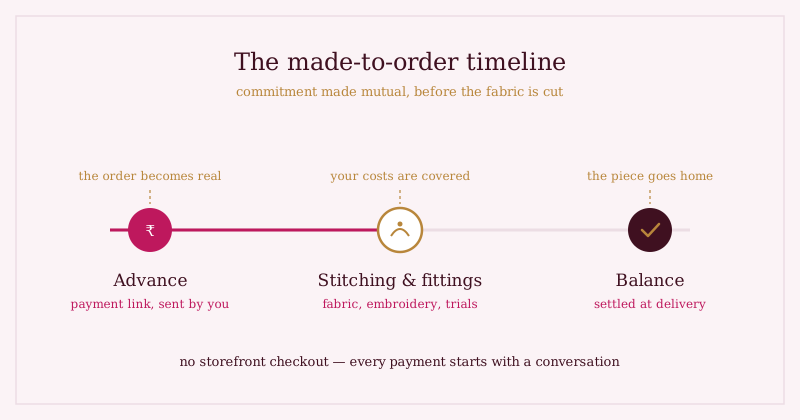
Two frictions kill advances. The first is the wording — solve it once by writing your version of: "Lovely — to book this in I take a 50% advance (₹6,000), balance on delivery. Sending the payment link now." Calm, standard, done. (The same never-type-it-twice rule from the WhatsApp playbook applies.)
The second friction is the paying. "Send to this number on GPay" works, but it ends in screenshot-forensics: was it ₹6,000 or ₹600, which order was it for, did it arrive at all? A proper payment link — created for this order, for this amount — removes the ambiguity. She taps, pays by UPI or card, and the payment is tied to the order it belongs to.
A payment link is not a checkout
Here's the distinction that matters. Adding a "Buy now" button to your shop page turns you into an e-commerce site — anonymous carts, no conversation, no chance to check the measurements or manage expectations on timelines. That's wrong for made-to-order work, where the conversation is the quality control.
A payment link is the opposite pattern: you decide an order is real, you attach a link for the amount you've agreed, and it travels inside the same WhatsApp chat where everything else was agreed. Payment stays personal and owner-initiated; it just stops being untraceable. Before any money moves, make sure the measurements are locked too — a deposit on a piece stitched to numbers that got lost protects nobody.
Where we're taking this next: part-payments tracked against a single order — advance, mid-fitting instalment, balance — with gentle reminders drafted for you when a balance is overdue.
Where Studio OS fits
Studio OS is built for exactly this owner-first payment pattern:
- Add an online payment link to any order — powered by Razorpay, for the amount you choose, when you choose. Nothing is charged without you initiating it.
- Your storefront stays conversation-first: no forced checkout. Customers request a piece on your shop page and you confirm personally, the way boutiques actually work.
- The link travels by WhatsApp like everything else — Studio OS drafts, you press send.
- The payment lands against the order, so "has she paid the advance?" is a glance at the order card, not a scroll through a chat.
Browse the demo shop to see the request-first flow, or start with Studio OS — and let the next ₹12,000 lehenga begin with a booking, not a hope.