4 min read
Customer follow-ups that sell (and feel like care)
She asked about the blue lehenga — revenue, if you remember. Follow-up reminders with the message pre-drafted turn memory into sales.
Picture a Sunday afternoon in the shop. A customer spends forty minutes with a blue lehenga — holds it against herself twice, photographs the dupatta, asks about altering the sleeve. "I'll confirm after I check with my sister," she says, warmly, and means it. The owner says "of course, no hurry," and means it too.
Then Monday brings a courier problem, Tuesday two fittings, Wednesday a festival order. By the time the blue lehenga crosses the owner's mind again, eleven days have passed, the moment has cooled, and messaging now feels like reopening a closed door. The sale didn't fall through. It just evaporated — as most boutique sales do, in the silence between "I'll confirm" and nothing.
The follow-up is the highest-value message you're not sending
Think about what a follow-up actually is: a message to someone who has already seen the piece, already liked it, already imagined wearing it. No advertisement reaches a warmer audience. Boutique owners who follow up consistently report the same pattern — a meaningful share of "let me think about it" conversations close within one gentle nudge.
Yet it's the first thing dropped when the week gets busy, for a simple reason: a follow-up has no deadline shouting at you. An order demands action; an enquiry pings; a follow-up just sits quietly in memory, waiting to be forgotten.
Why follow-ups curdle into marketing
The obvious fix — "just message everyone regularly" — is worse than the disease. A broadcast of "New collection! Visit us!" to two hundred numbers is marketing, and everyone can smell it. As the WhatsApp playbook puts it, that's how boutiques get blocked.
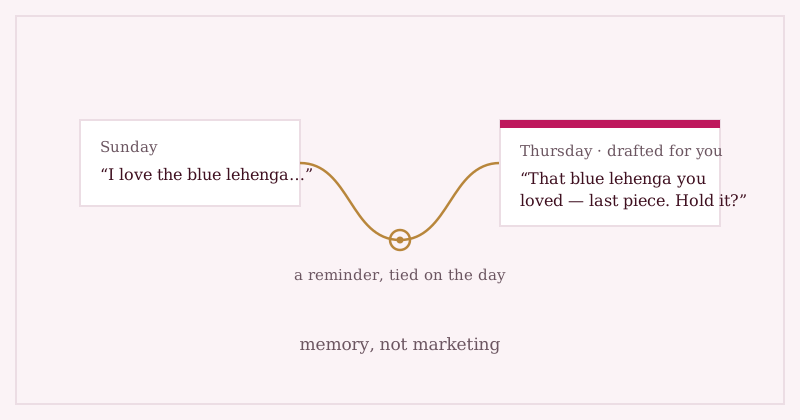
What makes a follow-up land is specificity: it mentions the actual piece, the actual conversation, the actual her. "That blue lehenga you loved — the sleeve alteration you asked about is no problem at all. Shall I keep it aside?" That message doesn't feel like marketing because it isn't. It's a shopkeeper remembering. The whole trick — and the whole difficulty — is the remembering.
A follow-up written from memory of a real conversation is care. The same message blasted from a list is spam. The words can be identical; the memory is the difference.
Capture at the moment of "maybe"
The workable system has two halves. First: set the reminder inside the moment, not after. When a conversation ends with interest but no decision, that's the trigger — ten seconds, before the next customer walks in: who, which piece, when to nudge. Wait until evening and half of them are gone.
Second: store the context with the reminder. "Follow up with Priya" on a to-do list is useless nine days later — which Priya, about what? The reminder must carry the piece and the thread of the conversation, so future-you inherits present-you's memory. This is exactly where a customer book that builds itself pays off: the reminder hangs on a real customer, with her history right there.
When the day comes, the last friction is composing the message while the shop is busy. If a draft is already waiting — built from the note, in your shop's voice, ready to edit — the follow-up takes fifteen seconds instead of requiring a quiet moment that never arrives.
Where we're taking this next: smarter timing — suggested nudge dates based on the kind of conversation, so festival-shopping interest isn't followed up after the festival.
Where Studio OS fits
Studio OS turns "I must remember to message her" into a system:
- Set a follow-up reminder on a customer in seconds — with a note like "she asked about the blue lehenga" attached.
- When it's due, the reminder surfaces with the message pre-drafted from your note — personal, specific, in your voice.
- You always press send. Studio OS drafts and reminds; it never messages your customers by itself, and it never will.
- Reminders live on the customer's card, beside her orders, enquiries and measurements — the memory and the relationship in one place.
Wander the demo shop to see where those conversations start, or begin with Studio OS — and let the next blue lehenga find its way home.